How RAG (Retrieval-Augmented Generation) Works
Published Oct 1, 2026
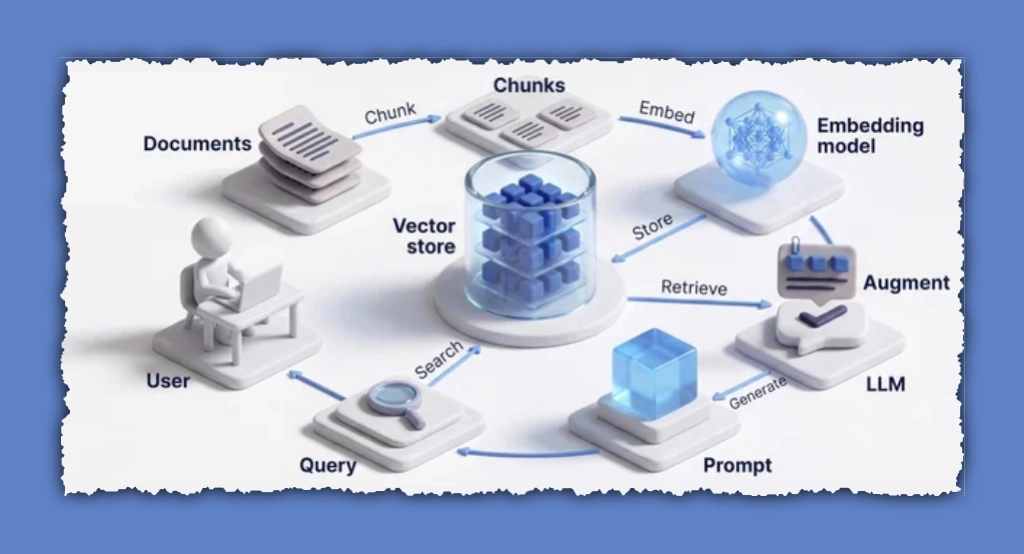
RAG connects an LLM to an external knowledge base so it can answer using information beyond what it was trained on. There are two phases: an indexing phase (done ahead of time) and a query phase (happens at runtime, per user query).
1. Indexing Phase
Documents → Chunked → Chunks
Source documents (PDFs, docs, web pages, etc.) get split into smaller chunks — typically a few hundred tokens each. Chunking matters because embedding a whole document loses granularity; you want retrieval to return focused, relevant passages, not entire files.
Chunks → Embedding Model → Embeddings → Vector Store
Each chunk is passed through an embedding model, which converts the text into a numeric vector that captures its semantic meaning. Those vectors (plus a reference to the original text) are stored in a vector store/database, indexed for fast similarity search.
2. Query Phase
User Query → Embedding Model
When a user asks a question, that query is also run through the same embedding model, turning it into a vector in the same space as the stored chunks.
Query Embedding → Vector Store → Retrieved Chunks
The vector store compares the query vector against stored chunk vectors (using cosine similarity or similar) and returns the top-k most relevant chunks.
Retrieved Chunks + Query → Augmented Prompt
The retrieved chunks are inserted into the prompt alongside the user’s original query. This combined prompt (query + retrieved context) is what gets sent to the LLM.
LLM Generates Response
The LLM reads the augmented prompt and generates an answer grounded in the retrieved content, rather than relying solely on its training data.
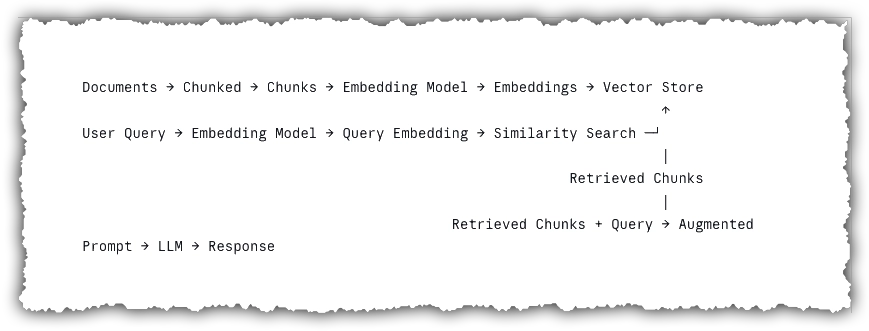
Flow Diagram
Key Insight
The embedding model is used twice — once to index the documents, once to embed the incoming query — and it’s the vector store’s retrieval result (not the embedding model itself) that augments what the LLM sees.
Next Steps
Topics worth exploring further:
- Chunking strategies (fixed-size, semantic, recursive)
- Embedding model choice (OpenAI, Cohere, open-source options)
- Retrieval methods (hybrid search, re-ranking, metadata filtering)